Inventory Valuation After You Pick a Method: Closing, Write-Downs, and Audits

Inventory valuation puts a dollar value on two things at the end of an accounting period: the units still on your shelves at the end of a period, and the units you sold during it. The first number appears on your balance sheet as ending inventory. The second becomes cost of goods sold (COGS) on your income statement.
Picking a costing method (FIFO, LIFO, or weighted average) is the well-covered part of this. Less covered is everything that method triggers afterward—at close—where it has to produce one defensible number that carries onto the financial statements, into the tax return, and through any review by an auditor or the IRS.
This post covers four things: why your physical inventory flow and costing method are separate decisions, how inventory value ends up on your books, when inventory may need to be written down below cost, and what documentation you'll need if someone reviews your numbers.
Physical rotation vs. Costing method
Under U.S. GAAP, the cost flow assumption used for accounting can differ from how goods physically move through a facility. ASC 330 permits FIFO, LIFO, weighted average, and specific identification, and the method chosen does not dictate which physical unit a worker picks. A grocer can rotate the oldest cartons to the front so milk sells before its date and still report inventory under LIFO or weighted average in the ledger.
Rotating oldest-first to limit spoilage is a stocking practice. The method used to cost inventory answers a separate question about reported profit and taxable income. The two answers do not have to align.

The accounting method itself does need to stay consistent. Once a method is chosen, ASC 330 expects it to be applied the same way each period. Changing it later calls for disclosure and a documented reason, and a LIFO election is harder still to reverse.
How inventory value ends up on your books
At close, the method divides the period's purchases and sales into two amounts drawn from the same pool of cost.
- One amount stays on the balance sheet as ending inventory, a current asset.
- The other moves to the income statement as COGS. Any cost not assigned to COGS remains in inventory.
For a business that holds stock, the balance sheet figure is often one of the largest current assets on the books. U.S. retailers carry roughly $1.43 in inventory for every $1 of sales (FounderJar), so an error in the valuation moves the balance sheet by a real amount.
The figure is only as sound as the counts under it. 2024 CAPS Research data put average inventory accuracy at 83%, with only about 69% of companies tracking the metric at all. Close to one in six records sits wrong before any costing method is applied. A correct method applied to a wrong quantity still returns a wrong value, so the count and the cost both have to be right.
When inventory gets written down below cost
The method sets what each unit cost at purchase. It doesn't set what the unit is worth at close. GAAP requires inventory to be carried at the lower of its cost or net realizable value (NRV), meaning the price you expect to sell it for minus what it takes to finish and sell it (e.g., cost of completion, disposal, and transportation).
When net realizable value drops below cost because stock is obsolete, damaged, or slow, inventory is written down to the lower figure, and the reduction is recorded in the period you recognize it.
The write-down only moves one direction under GAAP. Once you mark inventory down, that lower figure becomes its new cost, and you can't write it back up if the price recovers later (The CPA Journal). The loss is recorded now, and any recovery waits until the goods actually sell. IFRS handles this differently and does allow a reversal up to the original cost.

Applied to numbers: a unit recorded at $40 that with a NRV of $25 is carried at $25, and the $15 difference reduces income in the current period, no matter which costing method produced the original $40.
The items most likely to need this adjustment are stock that hasn't sold in months, stock past its selling season, and anything damaged or replaced by a newer version. Multiplying quantity by cost won't flag them, so you have to check for them directly before finalizing the valuation.
What you'll need when someone reviews your numbers
The valuation is a number that has to be supported with records once someone reviews it. An external audit and an IRS examination both begin at ending inventory and work back through the purchase and sale history that produced it, so the paper trail behind the figure carries the same weight as the figure itself.
Note that LIFO comes with one extra rule. If you use LIFO on your tax return, you have to use it on your financial statements, too. You can't show investors a higher profit under one method and report the IRS a lower one. The election is also hard to walk back and has to be supported by records an examiner can reproduce, so it's worth setting up with a CPA.
⚠️ None of this is tax advice.
Pull the valuation from your inventory records
The traditional close meant exporting every transaction, lining up quantity, unit cost, and amount for each item, then layering formulas to total it. More transactions meant more time, and a single formula that failed to copy down could skew the total that went straight onto the books.
A system that already holds stock-in and stock-out history can produce the valuation from that data without re-keying.
In BoxHero, that's the Custom Analytics feature.
What is Custom Analytics?
This tool builds a report from data already in your team: items, attributes, prices, dates, and suppliers. It runs on SQL, so you can pull views the standard inventory reports don't show and save them to rerun each period.
You don't have to write the SQL yourself. BoxHero's built-in AI Assistant generates the query from a plain-language request.
On the web app, open Reports > Custom Analytics > + New, then describe what you want. For example: "Calculate the current FIFO inventory value for each item in stock, valuing each item's quantity on hand at its most recent purchase order costs first."
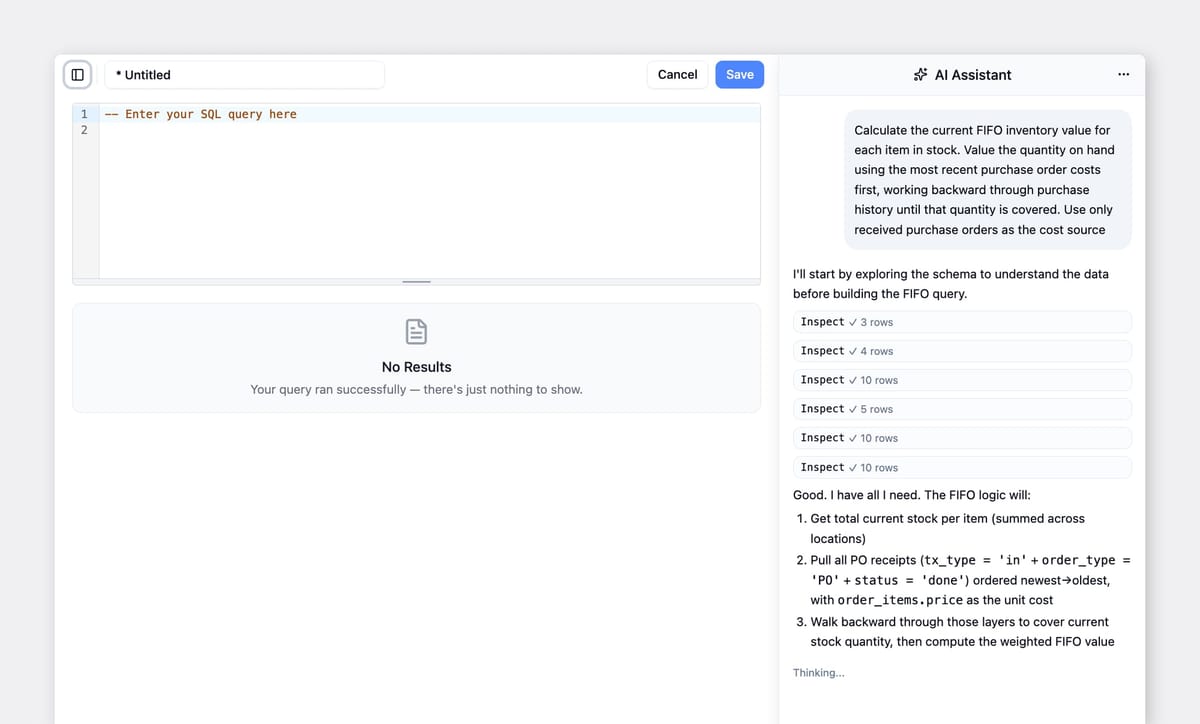
The Assistant returns a query you can run and save, and BoxHero support can help when a query returns something unexpected.
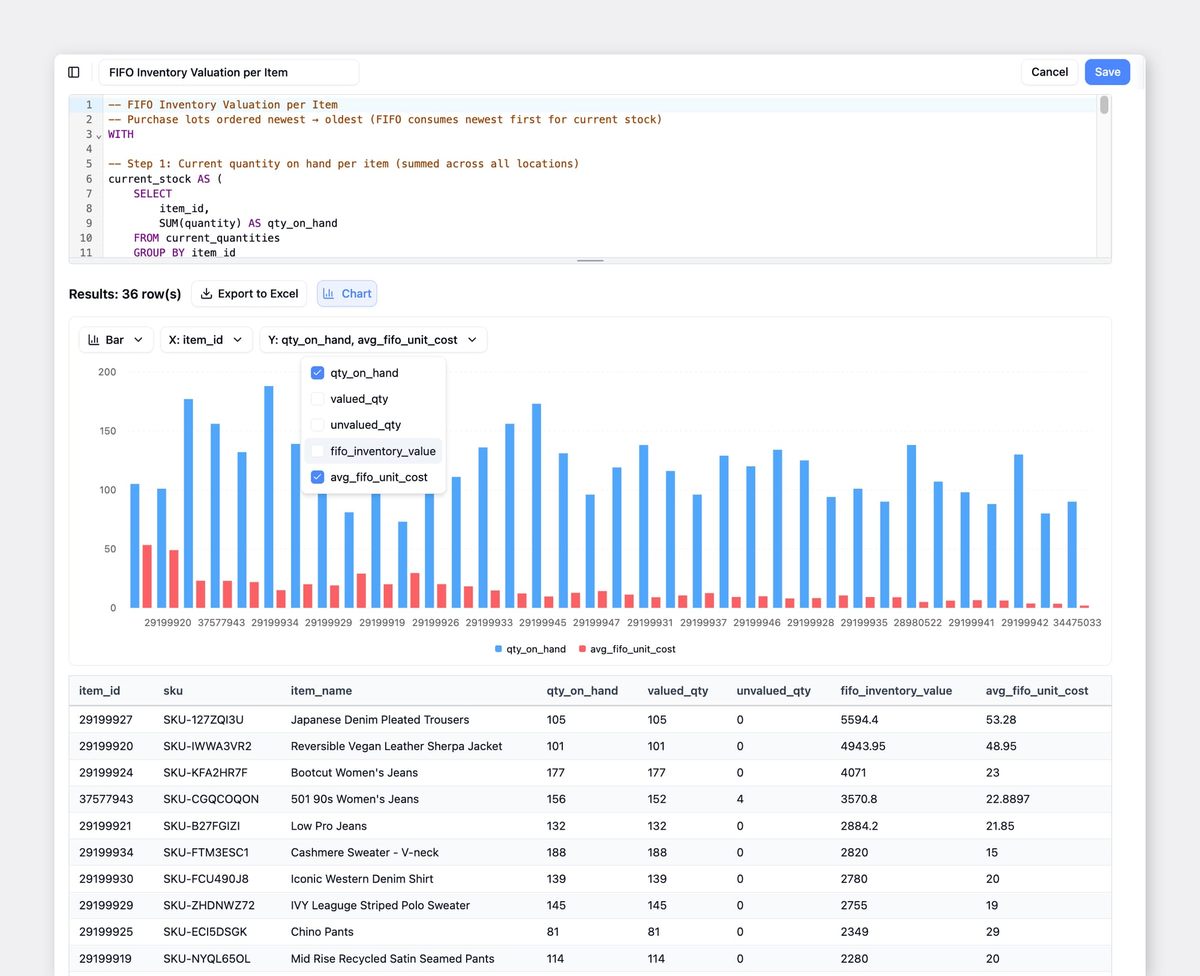
After that, whoever records Stock In and Stock Out transactions keeps doing that, and whoever handles the books opens the report and reads the current inventory value. At close, that figure goes onto the balance sheet. During an audit or IRS exam, it's the source data behind the number.
Choosing a costing method is one decision among several. The value still has to be booked correctly, tested against net realizable value, and backed by records that hold up under review.
A system that records every stock movement as it happens keeps that trail in place, so the number you report at close lines up with the stock you're actually have.
RELATED POSTS
 Ekaterina Glozshtein
 BoxHero
 Ahrom Yoo